Dad's Campfire Tale About the Lost Scouts Was Never Fiction — I Have the Newspaper That Proves It
The Ritual of Summer Nights
Every August, our family would spend a week at Lake Moraine in the Pennsylvania mountains. Same cabin, same hiking trails, same ritual around the campfire on the last night. Dad would wait until the flames died down to glowing embers, until my sister and I were leaning forward in our folding chairs, and then he'd tell us about the lost Boy Scout troop.
 Photo: Lake Moraine, via images.fineartamerica.com
The story never changed. Not a single detail.
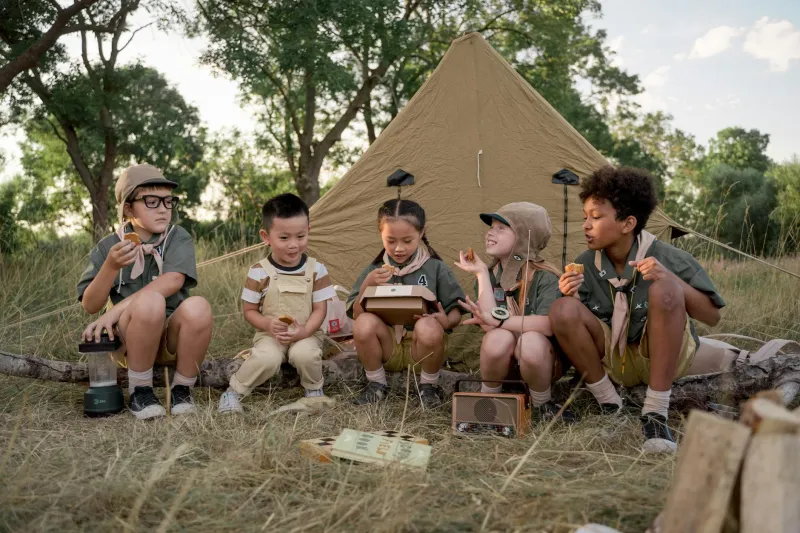
Troop 47 from somewhere downstate had come to the mountains for a week-long camping expedition in the summer of 1963. Twelve boys, ages eleven to fourteen, plus their scoutmaster and an assistant leader. They'd set up camp in a clearing about three miles north of where we sat, planning to work on their hiking and wilderness survival merit badges.
On the third morning, the assistant leader had hiked back to town for supplies. When he returned that afternoon, the campsite was empty. Tents still pitched, food still hanging in bear bags, a pot of coffee still warm over the fire. But no people.
The search lasted two weeks. State police, volunteer firefighters, even bloodhounds brought in from Pittsburgh. They found nothing — no tracks leading away from the campsite, no signs of struggle, no indication that thirteen people had simply walked into the forest and vanished.
Except for the sounds.
Local hikers reported hearing voices in the deep woods, always just beyond sight. Children calling for help, a man shouting instructions, the distant sound of someone chopping wood. But when searchers followed the voices, they found only empty forest.
After two weeks, the search was called off. The missing scouts were declared dead in absentia. The campsite was marked off-limits and eventually reclaimed by the forest.
"But sometimes," Dad would say, his voice dropping to just above a whisper, "on quiet nights like this, you can still hear them calling for their scoutmaster. Still trying to find their way home."
The Box in the Attic
Dad died last October, massive heart attack while raking leaves in his backyard. Mom asked me to help clear out his study, and that's when I found the shoebox hidden behind his old camping gear in the attic.
Inside were dozens of newspaper clippings, all carefully preserved in plastic sleeves. Most were from the 1960s, yellowed local papers from small Pennsylvania towns. But the one on top made my hands shake.
SEARCH CONTINUES FOR MISSING BOY SCOUT TROOP
The search entered its second week today for thirteen members of Boy Scout Troop 47 who disappeared from their campsite in the Allegheny Mountains. The group, led by Scoutmaster William Henley of Johnstown, was reported missing when assistant leader Robert Morrison returned from a supply run to find their campsite abandoned...
 Photo: Allegheny Mountains, via korns.org
The article was from the Clearfield Progress, dated August 15, 1963.
Every detail matched Dad's story exactly. The troop number, the number of missing scouts, even the assistant leader's name. But there was one detail Dad had never mentioned in his campfire tales.
The scoutmaster's name was William Henley.
My father's name was William Henley.
The Rest of the Story
I read every clipping in that box. The search efforts, the interviews with local residents, the gradual shift from rescue operation to recovery mission. And then, three weeks after the disappearance, a small follow-up article buried on page six:
ONE SCOUT FOUND ALIVE
A member of the missing Boy Scout troop was found yesterday by hunters approximately eight miles from the original campsite. The boy, whose name is being withheld pending notification of family, was discovered in a state of severe dehydration and exposure. He has no memory of the past three weeks or the fate of his fellow scouts...
The article mentioned that the boy was being treated at Clearfield Hospital and would be released to family members once his condition stabilized.
I called the hospital the next day. After being transferred between three different departments, I finally reached someone in medical records who was old enough to remember 1963.
"Oh yes, the scout boy," she said. "Terrible thing. We don't normally keep records that old, but that case was so unusual... Let me see... yes, here it is. William Henley, age twelve. Poor child was in shock for days, kept asking for his troop leader."
She paused.
"Funny thing, though. He kept insisting his name was Billy, not William. And he kept talking about his father back in Johnstown, but according to our records, he was an orphan. No family to speak of."
The Photograph
At the bottom of the shoebox, wrapped in tissue paper, I found a black and white photograph. Thirteen boys in Boy Scout uniforms, standing in front of a canvas tent. They looked exactly like Dad had always described them — young, eager, ready for adventure.
The boy in the front row, kneeling with a merit badge handbook in his hands, looked exactly like the pictures I'd seen of my father as a child.
On the back of the photograph, written in faded ink: Troop 47, Summer 1963. Last day of camp.
What I Know Now
I've been back to Lake Moraine three times since finding that box. I've hiked the trails Dad showed us, found the clearing where he claimed the scouts had camped. There's nothing there now but old-growth forest and the kind of deep silence that makes you hear your own heartbeat.
But on my last visit, just as the sun was setting, I heard voices in the distance. Children calling out, a man shouting instructions, the rhythmic sound of someone chopping wood.
I followed the sounds for twenty minutes, crashing through underbrush and scrambling over fallen logs. But I never found the source.
When I finally stopped to catch my breath, the voices had faded to nothing.
I think I understand now why Dad told that story every summer. Why he never changed a single detail, never embellished or improved the tale for dramatic effect.
It wasn't a ghost story.
It was a memorial.
For twelve boys and a scoutmaster who never made it home, and for the child my father had been before he walked out of those woods alone, carrying a story he would spend the rest of his life trying to tell.