Sarah had always hated cleaning out houses after funerals. There was something deeply unsettling about sorting through the remnants of a life, deciding what deserved to survive and what could be thrown away. But Grandma Eleanor's Victorian in Salem felt different. It felt like it was watching her work.
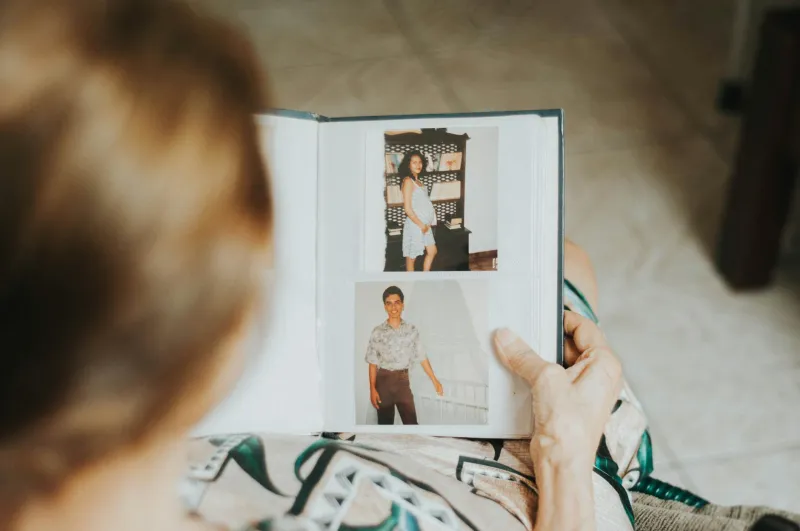
She'd been at it for three days, boxing up clothes and books, when she found the photo albums. Dozens of them, stacked in the hall closet like a paper tower of family history. Eleanor had been meticulous about documentation—every birthday, every holiday, every random Tuesday afternoon seemed to have warranted a photograph.
Sarah settled into the living room with the first album, a burgundy leather book marked "1962-1975." The early photos were standard family fare: Eleanor as a young mother, Sarah's grandfather before the cancer took him, various relatives posed stiffly in living rooms and backyards. But as she flipped through the pages, something began to nag at her.
In the background of a 1964 Christmas morning photo, behind the tree and wrapping paper chaos, there was a doorway. Just barely visible in the frame's edge, it stood partially open, revealing nothing but darkness beyond. Sarah almost missed it—just a sliver of shadow that could have been anything.
But then she saw it again. Different room, different year. A 1967 birthday party in what looked like the kitchen, and there it was in the background: the same door, opened to the same precise angle, the same quality of darkness beyond.
Sarah grabbed the next album. "1976-1988." She flipped through more carefully now, studying each background, each corner of every frame. The door appeared in at least half the photos. Sometimes it was barely visible, sometimes it dominated the background like a dark mouth waiting to swallow the scene. But it was always the same door, always opened to that exact angle, always revealing nothing but black space.
The rational part of her mind offered explanations. Old houses had lots of doors. People left them open. It was probably just a coincidence, or maybe Grandma Eleanor had a habit of keeping one particular door ajar. But Sarah had spent enough summers in this house to know every room, every hallway, every doorway. She couldn't place this door anywhere in the Victorian's layout.
By evening, she'd gone through six albums. The door appeared in photos from the 1960s through the 2000s, spanning four decades of family history. It showed up in pictures taken in different rooms, from different angles, but it was always the same door. Always that precise degree of openness, always that impenetrable darkness beyond.
Sarah called her cousin Mark. He'd spent as much time in the house as she had growing up.
"Hey, weird question," she said when he picked up. "Do you remember a door in Grandma's house that was always kept open? Like, partially open? Maybe leading to a closet or storage room?"
There was a long pause. "Why are you asking about that?"
"You remember it?"
"Sarah." Mark's voice had gone quiet. "You need to stop looking at those pictures."
"What do you mean?"
"Just... box them up. Don't go through them anymore. Some things in that house are better left alone."
He hung up before she could ask what he meant.
Sarah spent the next hour staring at a 1983 photo of her own fifth birthday party. There she was, gap-toothed and grinning, blowing out candles on a cake. And there, in the background behind the dining room table, was the door. Always watching, always waiting.
She was about to close the album when she noticed something tucked behind the back cover. A single photograph, older than the rest, its edges yellowed with age. No date, no context, just a image of a hallway she didn't recognize.
The photo showed a long corridor lined with doors. All of them were closed except one—the one at the very end of the hall. It stood open at that familiar angle, and for the first time, Sarah could see what lay beyond the threshold.
It was another hallway. Another corridor lined with doors. And at the end of that hallway, another door stood open, revealing another corridor beyond.
The image seemed to stretch infinitely inward, door after door after door, each one a little smaller, a little darker, until the perspective collapsed into a point of absolute black.
On the back of the photograph, in her grandmother's careful handwriting, were four words: "The door remembers everything."
Sarah set the photo aside and looked around the living room. For the first time since she'd arrived, she noticed that one of the doors leading to the hallway was standing slightly ajar. She was certain she'd closed it earlier.
As she watched, it opened a little wider.
Somewhere in the house, she could hear the soft click of a camera shutter.