Always in Your Peripheral
There's something fundamentally wrong about the Hidebehind, and it's not what you think.
Most cryptids have the courtesy to be seen. Bigfoot poses for blurry photos. The Jersey Devil shows up in woodcuts. Even Mothman had the decency to perch on a bridge where people could point at it.
The Hidebehind has never been directly observed. Not once. Not ever.
That should make it easier to dismiss as folklore, but it doesn't. If anything, it makes the reports more disturbing, because they're all describing the exact same impossible thing: a presence that's always there when you're not looking, and never there when you are.
Logging Camp Origins
The name first appears in 19th-century logging camp records from Michigan and Wisconsin. Foremen would blame missing workers on "the hidebehind" - something that supposedly stalked lumberjacks in the deep woods, always positioning itself just outside human vision.
Initially, it seemed like dark humor. Logging was dangerous work. Men disappeared into the wilderness and never came back. Bears, wolves, accidents, hypothermia - the woods had plenty of ways to kill you without invoking supernatural explanations.
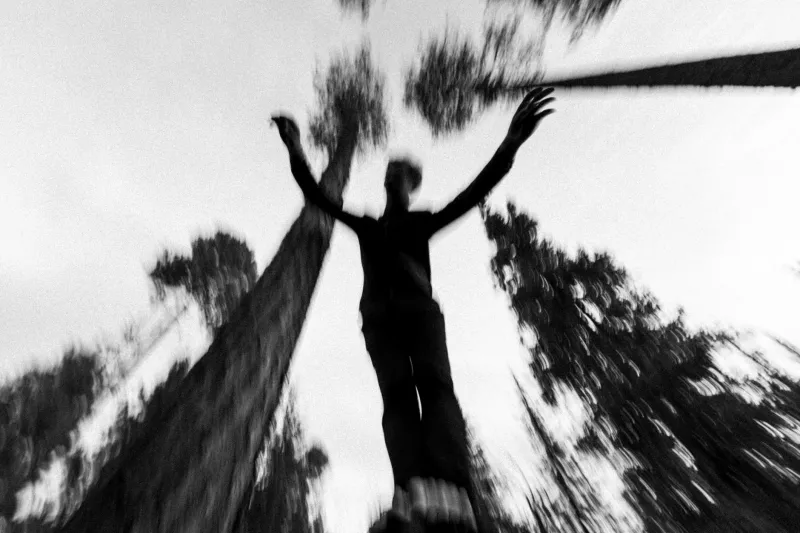
But the reports were too specific to be random superstition. Workers described the same sensations: the feeling of being watched, peripheral movement that vanished when you turned your head, the absolute certainty that something large was keeping pace with you through the trees.
More disturbing were the behavioral changes. Experienced woodsmen who'd spent decades in the forest would suddenly refuse to work alone. They'd insist on staying in groups, always positioning themselves so someone was watching their back.
These weren't superstitious immigrants clinging to Old World fears. These were practical men who knew every dangerous animal in the North American wilderness. They knew what bear sign looked like, how wolves moved, what mountain lions sounded like in the dark.
This was something else.
The Pattern Spreads
By the 1920s, similar reports were emerging from logging operations across the Pacific Northwest, the Appalachians, and the Canadian Rockies. Always the same description: something large moving through the trees, perfectly synchronized with human movement, never quite visible.
 Photo: Pacific Northwest, via www.tripsavvy.com
The Forest Service started tracking incidents informally. Not because they believed in monsters, but because workers were abandoning profitable timber operations, claiming the woods were "occupied." Entire crews would walk off the job after a few days, citing an overwhelming sense of being hunted.
What made the reports credible was their restraint. Nobody claimed to see a creature. Nobody described attacks. Workers just reported feeling stalked by something that understood human behavior well enough to always stay hidden.
Modern Encounters
Fast forward to today, and the reports haven't stopped. They've just moved online.
Hiking forums are full of accounts that match the historical pattern perfectly. Backpackers describe feeling followed on remote trails, always sensing movement in their peripheral vision that disappears when they turn to look.
A typical post from r/hiking, October 2023:
"Day 3 of a solo hike in Olympic National Park. Can't shake the feeling something's been pacing me since yesterday. Never see it directly, but there's always movement just outside my vision. Tried doubling back to catch it - nothing there. But as soon as I start hiking again, the sensation returns. It knows I'm alone out here."
 Photo: Olympic National Park, via explorewithalec.com
Wilderness photographers report the same phenomenon. Hours of footage showing empty forest, but they swear something was moving parallel to their position the entire time. Trail cameras pick up nothing, but hikers consistently report feeling watched in the same geographic areas.
Why It Works
The genius of the Hidebehind isn't supernatural - it's neurological.
Human peripheral vision is designed to detect movement, not detail. It's an evolutionary early warning system that kept our ancestors alive on the African savanna. When something moves at the edge of your vision, your brain screams "PREDATOR" before your conscious mind can process what you're actually seeing.
The Hidebehind exploits this perfectly. It's always in that zone where your brain knows something's there, but your eyes can't confirm it. The result is sustained, low-level terror that builds over hours or days.
It's psychological warfare conducted by something that understands human sensory limitations better than we do.
The Question Nobody Wants to Ask
Here's what bothers me about the Hidebehind reports: they're too consistent across time and geography to be random folklore, but too impossible to be describing a real animal.
Unless it's not an animal.
What if it's something that evolved specifically to hunt humans? Something that learned our behavioral patterns over thousands of years and adapted to exploit our sensory blind spots?
Every predator develops hunting strategies suited to its prey. Lions hunt in coordinated groups because zebras have excellent peripheral vision. Wolves hunt in packs because elk are faster than any individual wolf.
What kind of hunting strategy would you develop for humans?
You'd stay hidden. You'd move when they move, stop when they stop. You'd position yourself where their vision is weakest. You'd make them aware of your presence without ever letting them see you directly.
You'd make them feel hunted.
You'd become something that lives in peripheral vision, because that's where human fear lives too.
Still Out There
The reports continue. Every year, hikers and hunters describe the same impossible stalker moving through America's forests. Always there, never seen.
Maybe it's mass hysteria. Maybe it's evolutionary memory of ancient predators that once hunted our ancestors.
Or maybe something figured out how to hunt us perfectly, and it's still out there, always just outside our line of sight, waiting for us to venture into the woods alone.
Next time you're hiking and feel like you're being watched, don't turn around quickly to look.
Some things are better left unseen.