The Room Beneath Our Kitchen That County Records Say Exists
The Discovery in the County Clerk's Office
I only went to the county clerk's office because of the estate sale. Mom had passed six months earlier, and we needed to transfer the deed on the house where I'd grown up. Standard paperwork, nothing complicated—until the clerk handed me a manila folder and said, "Interesting place you folks had there. Don't see many houses built with that kind of basement anymore."
I told her there wasn't a basement. Never had been. The house was built on a concrete slab in 1967, same as half the subdivision.
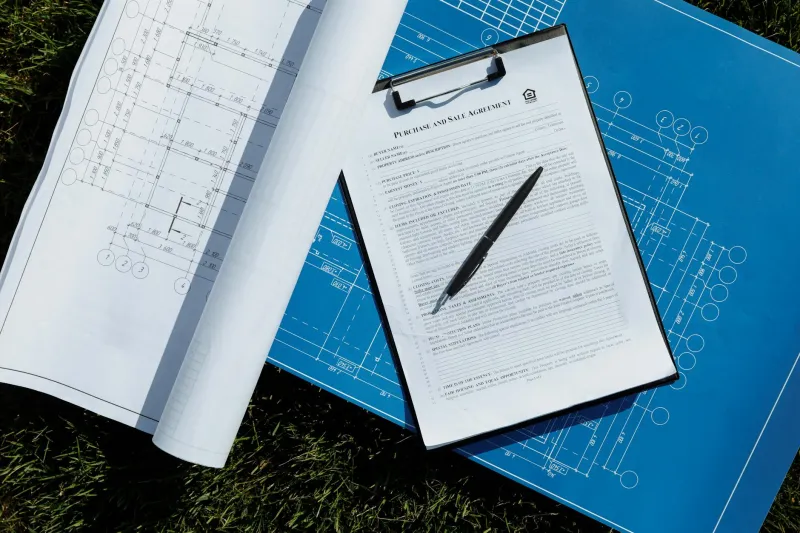
She looked at me strangely and opened the folder. Inside were the original architectural plans, stamped and signed by Morrison Construction Company. The basement level was clearly marked, complete with dimensions and what looked like a small room in the southeast corner labeled simply "observation."
"These are the wrong plans," I said.
But the address was right. The lot number matched. Even the specific modifications my parents had requested—the extended kitchen counter, the extra bedroom window—were all there on the main floor plans.
The Contractor's Son Remembers
Morrison Construction went out of business in the eighties, but I tracked down Jim Morrison Jr., whose father had built our house. He agreed to meet me at a diner off Route 36, and when I showed him the blueprints, his coffee cup stopped halfway to his mouth.
"Jesus," he whispered. "I haven't seen these in forty years."
"So you remember building the basement?"
Jim set down his cup and stared at the plans for a long time. "We dug it. Poured the walls. Even installed the stairs." He pointed to a detail I hadn't noticed—a staircase leading down from what would have been our kitchen pantry. "But then your folks changed their minds."
"Changed their minds about what?"
"About keeping it." He looked uncomfortable. "They had us fill the whole thing with concrete. Said they didn't want any access to the lower level. Made us pour right over the stairs, seal up the door. Dad charged them extra for all that concrete, but they paid without arguing."
I thought about our kitchen pantry. It had always been oddly shallow, barely deep enough for canned goods. If there had been stairs there once...
"Did they say why they wanted it sealed?"
Jim shook his head. "But I remember the night crews."
The Night Crews
According to Jim, his father had hired a separate crew to work on our basement. They only came at night, and they brought their own equipment. Jim had been sixteen at the time, working summers for his dad, but he'd never been allowed to work the night shifts on our house.
"Dad said it was specialized work. Something about the observation room needing specific features." He paused, drumming his fingers on the table. "I drove by one night around midnight, just curious. There were more cars there than made sense for a construction crew. Nice cars. And the basement windows were lit up, but the light was... wrong somehow."
"Wrong how?"
"Too bright. Too white. Like looking into a photographer's studio."
I asked him if he remembered when the basement was sealed, and he gave me an exact date: October 15th, 1967. Three weeks before my family moved in.
The Neighbor's Memory
Mrs. Chen had lived next door since 1965. She was in her nineties now, but her memory was sharp. When I asked her about the construction on our house, her expression grew guarded.
 Photo: Mrs. Chen, via assets.mycast.io
"I remember the lights," she said. "Every night for weeks, those bright lights in your basement windows. And the sounds."
"What kind of sounds?"
"Machinery. But not construction machinery. Something... precise. Like medical equipment." She paused, studying my face. "Your parents were very specific about the landscaping afterward. Insisted on planting those evergreen shrubs right against the foundation. Said they wanted privacy."
I thought about those shrubs. They'd been there my entire childhood, thick and overgrown, completely blocking the view of the foundation on the southeast side of the house. The side where the observation room would have been.
"Mrs. Chen, did you ever ask my parents about the basement?"
"Once. Your mother said they'd decided they didn't need the extra space." She looked away. "But I saw her down there before they sealed it."
The Photograph
Going through Mom's belongings, I found the box of photos from our move-in day. Most were typical family shots—Dad carrying boxes, me as a toddler playing in the yard. But one photo stopped me cold.
It was taken in our kitchen, showing Mom unpacking dishes. In the background, clear as day, was an open door where our pantry wall now stood. Beyond the door, I could see wooden stairs leading down into darkness.
I flipped the photo over. In Mom's handwriting: "Last day with the door - October 1967."
I compared the photo to our current kitchen. The door was gone, the wall seamless. But the proportions were wrong. The pantry was definitely shallower than the space in the photo suggested.
The Surveyor's Note
Back at the county office, I requested every document related to our property. Buried in the surveyor's reports was a hand-written note in the margin of the final inspection:
Foundation sealed per owner request. Basement level filled with concrete 10/15/67. Do not document reason - see private agreement file.
When I asked about the private agreement file, the clerk said those records were sealed for seventy-five years from the date of construction. They wouldn't be available until 2042.
"Who requested the seal?" I asked.
"Doesn't say. Just lists it as 'concerned parties.'"
What Remains Below
I hired a ground-penetrating radar company to scan our foundation. The results confirmed what I already knew: there's a hollow space under our kitchen, roughly twelve by eight feet. The concrete above it is only six inches thick—enough to support the floor, but thin enough that you could break through it with the right equipment.
The radar also picked up what the technician called "anomalies" in the sealed space. Metal objects, possibly equipment. And something else—regular geometric shapes that don't match any construction materials.
"Looks like furniture," the technician said. "Maybe filing cabinets."
I think about that observation room every time I'm in the kitchen. Whatever my parents wanted to hide down there, it's still there. Waiting in the dark under six inches of concrete, preserved exactly as it was fifty-four years ago.
Sometimes, late at night, I put my ear to the kitchen floor and listen. I tell myself I'm imagining the faint humming sound, the occasional click like machinery cycling on and off.
But I'm not imagining the warmth. That spot on the floor, right where the observation room would be, is always ten degrees warmer than the rest of the kitchen.
I've thought about breaking through the concrete. I have the blueprints. I know exactly where to dig.
I just can't shake the feeling that whatever's down there is still watching. Still observing. And maybe some doors are meant to stay sealed.