My Dentist Says He Did Work on Teeth I Still Have — His Chart Shows Them Gone
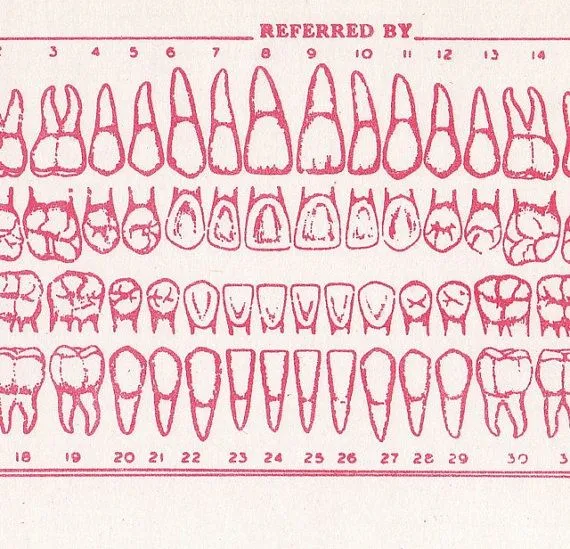
Photo: vintage dental chart teeth diagram paper records close up, via i.pinimg.com
I only requested my records because I was switching insurance and the new plan wanted a full dental history going back as far as I could provide. It was supposed to be paperwork. It was supposed to be the most boring errand of my month.
The file came by mail in a large envelope, maybe forty pages: intake forms, treatment notes, a series of hand-drawn tooth charts going back to 1993, when I was eight years old and my family started seeing Dr. Emmett Pruitt out of his practice on Bellfield Avenue. My family had gone to Dr. Pruitt for everything. My parents, my brother, me. He'd retired a few years ago, but his records had been transferred to a Dr. Anaya who kept the same office and, apparently, the same filing system.
I sat down at my kitchen table and started going through it the way you go through any old file — half-attentive, looking for the summary information, not expecting to read every page. But something snagged my attention about twenty pages in, on a treatment note dated April 14, 1997.
The note documented the extraction of tooth number 14, the upper left first molar, following a failed root canal. The chart attached to that note showed the tooth as absent — a blank space in the diagram, the kind of cross-hatch marking that means no longer present. The note was signed by Dr. Pruitt. His handwriting was small and even, the kind that comes from years of writing in narrow chart margins.
I have tooth number 14. I ran my tongue along my upper left molars right there at the kitchen table, pressing into the familiar ridged surface, and it was there. It has always been there. I have never had a root canal. I have never had any tooth extracted. I know this the way you know your own body — not because you've checked recently, but because you would remember.
I kept reading.
By the time I'd gone through the full file, I had found records of four extractions, two root canals, and one notation about a partial bridge on the lower right side, all dated between 1997 and 2003. Every single tooth involved was, as far as I could tell with my own tongue and a bathroom mirror, still in my mouth. The chart diagrams showed a mouth with significant gaps and restorations. My mouth has none.
I called Dr. Anaya's office the next morning and asked to speak with someone about a discrepancy in my records. The receptionist was pleasant and put me through to the office manager, a woman named Debra, who asked me to come in so they could pull the physical file.
I went on a Thursday afternoon. Debra had the file on the desk when I arrived, and she'd flagged the same pages I'd been looking at. She seemed genuinely puzzled — the practiced, careful puzzlement of someone trying to be helpful without committing to anything. She said Dr. Anaya was between patients and would come speak with me.
Dr. Anaya was a tall man in his late fifties who had clearly been briefed on the situation before he walked in. He looked at the chart, looked at me, and said he'd like to do a quick visual exam if I didn't mind. I didn't mind. I sat in the chair and opened my mouth and he looked for about ninety seconds without saying anything.
When he was done, he said: "Your dentition is complete. All present and healthy."
I asked him what that meant for the records.
He was quiet for a moment. Then he said he'd like to pull the original X-rays from the archive to compare. Debra went to look. She came back ten minutes later and said the X-rays from that period weren't in the physical archive. She said they should have been scanned when the practice transitioned to digital in 2009, but there was no scan on file for my records prior to 2011.
There was no imaging. Just the charts. Just Pruitt's handwriting, describing work on teeth that are still in my mouth.
I asked if there was any way to reach Dr. Pruitt. Debra looked at Dr. Anaya. He said Pruitt had been in declining health since his retirement and wasn't really reachable. He said it in the tone people use when they mean something more final than they're willing to say outright.
I pushed, gently. I said I just wanted to understand the discrepancy.
Dr. Anaya looked at the chart one more time. He looked at it the way you look at something you recognize but can't quite place — not confused, exactly, but careful. He said, "I'm sure there's a clerical explanation," and I noticed that he didn't say he thought there was a clerical explanation. He said he was sure.
I have the file at home now. I've read it probably a dozen times. The procedures are detailed — specific, clinical, the kind of notes that come from memory or observation, not from guessing. Pruitt wrote, in April of 1997, that the patient tolerated the procedure well and was advised to eat soft foods for forty-eight hours.
I don't remember any of it. I don't remember the appointments, the chair, the numbness, the soft foods. I don't remember losing those teeth.
And I still have them.
I've started to wonder which version of the story is the one I'm actually living in — the one where nothing happened and the records are wrong, or the one where something happened and I'm the part that doesn't remember. I keep running my tongue over my molars in quiet moments, pressing into each one, making sure.
So far they're all still there.
I'm not sure that makes me feel better.