We've Eaten at the Same Diner on Old 61 Since 1978 — Satellite View Shows an Empty Field

Photo by Photo by Sikes Photos on Unsplash on Unsplash
My family is not sentimental about much, but we are sentimental about food, and we are especially sentimental about the diner on Old 61 south of Sikeston, Missouri, which my great-grandmother discovered on a drive in 1978 and which four generations of us have stopped at every time we pass through that stretch of highway. It has no name that anyone can remember clearly — my grandmother called it the Waypoint, my mother calls it the yellow place because of the sign, I've always just thought of it as the diner on Old 61. We have photographs going back to that first visit. We have a tradition.
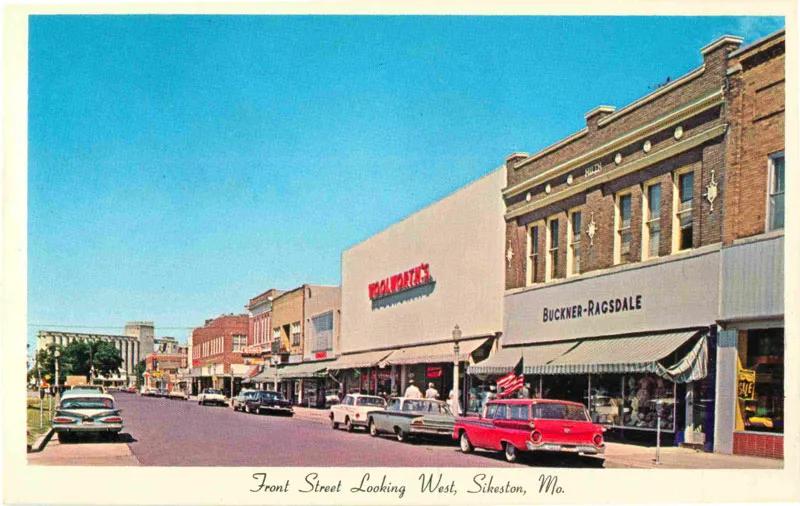 Photo: Sikeston, Missouri, via mygenealogyhound.com
I started pulling things apart last fall, the way you do when you have too much time and a laptop and a mild anxiety disorder that sometimes disguises itself as research.
The satellite image on Google Maps shows a field. Not a parking lot, not a vacant lot with a foundation, not any evidence that a structure ever stood there — just a flat stretch of scrubby Missouri farmland running alongside the highway, the kind of terrain that looks like it's been that way since before the road was paved. I checked the coordinates three ways. I drove the route on Street View and watched the mile markers. The diner, if it exists in the physical world, occupies a spot that every available aerial and satellite source agrees is empty ground.
That's strange enough on its own. But then I started going through the photographs.
We have maybe thirty of them across the decades. My great-grandmother at a window booth in 1978, a cup of coffee in front of her, wearing a yellow blouse I recognize from other photos of that era. My grandmother and her sister in 1985, sharing a piece of pie. My mother's family on a road trip in 1993, my older brother small enough to be in a booster seat, the red vinyl of the booth visible behind him. Me and my cousin in 2011, grins that look road-trip-genuine, the kind of tired-happy you get after six hours in a car.
I've been studying these photographs for about three months now and I want to tell you what I noticed, though I want to be careful because I'm aware of how this sounds.
Nobody in any of them looks comfortable.
I don't mean frightened. I don't mean obviously distressed. I mean there's something in the posture of every person photographed inside that diner across forty-plus years that sits slightly wrong when you look at it long enough. My great-grandmother's smile in 1978 doesn't reach her eyes in the way her smile reaches her eyes in every other photograph I have of her from that decade. My grandmother and her sister are angled slightly away from each other in a way that doesn't match how close they were. My brother, in 1993, is looking at something outside the frame of the photograph — not out the window, but behind the camera, behind whoever is taking the picture — with an expression I can only describe as watchful.
I'm in the 2011 photo. I remember that stop. I remember the pie and the coffee and the way the afternoon light came through the windows and my cousin's laugh when she spilled her water. I remember feeling fine. I remember it as a good stop on a long drive.
But when I look at myself in that photograph, I look like someone who is waiting for something to be over.
I've tried the county property records for that parcel. The ownership history is clean and agricultural going back to 1954 — a family name that appears on several local farms in that area, no commercial development ever recorded. I filed a FOIA request with the Missouri Department of Health asking for any food service establishment permits issued for that highway corridor between 1975 and 2015. The response listed eleven locations. None of them matched the coordinates. None of them matched a name my family could recognize.
I called my mother last week and told her what I'd found. There was a pause before she answered that was just a beat too long.
"We always stopped there," she said. "Every single time."
I asked her if she remembered it clearly. What the food was like, what the staff looked like, anything specific.
Another pause. "It was good," she said finally. "It was always a good stop. We always felt better after."
I asked her what she meant by that — better than what, better after what.
She said she didn't know exactly. Just that by the time they got back in the car, whatever had felt wrong about the drive up to that point was gone. She said she'd assumed that was just what a good meal did for you.
I haven't driven Old 61 since I started looking into this. I'm not sure I'm ready to find out whether the field is still empty, or whether — if I drove down that stretch of highway with enough miles behind me and the right kind of tired in my bones — something would be open and lit up and waiting, the way it always has been.
I'm not sure which answer would be worse.