Dad Drove Thousands of Miles He Never Mentioned — I Finally Found the Road He Kept Going Back To
My father was the kind of man who saved every receipt and logged every oil change in a spiral notebook he kept in the glovebox. Not because he was anxious or compulsive — he just believed that if a thing was worth doing, it was worth keeping track of. He'd maintained that habit since 1987, when he bought his first truck, and by the time he died last March he had a shoebox containing eleven spiral notebooks, each one labeled by year, each one filled with his small, level handwriting: date, mileage, service performed, cost. He was proud of those logs. He showed them to me once and said they were proof that a machine would give back what you put into it.
I inherited the truck. A 2014 F-150, navy blue, 94,000 miles on the clock. I wasn't going to keep it — I live in a city, I have a sedan — but I couldn't sell it immediately either, so it sat in my driveway for two months while I sorted through everything else. One evening I brought the shoebox inside and started reading through the notebooks, the way you read through a dead person's things when you're looking for them in the ordinary details.
The discrepancy jumped out at me on the second-to-last notebook. He'd had the truck serviced in April of two years ago at 79,400 miles. The next entry was in September of the same year: oil change, 82,100 miles. Five months, 2,700 miles. He'd told us all summer he wasn't getting out much, that his knee was giving him trouble, that he was mostly staying close to home. Home to the nearest town with a grocery store is eleven miles. I pulled up my own text messages from that period and found a dozen exchanges where he mentioned not driving, not feeling up to it, staying in.
I went through every entry for the last two years of his life. When I compared the logged mileage intervals against what he'd told us about his movements — the family visits I remembered, the doctor appointments my sister had driven him to, the hardware store runs he'd mentioned — I came up roughly 3,800 miles short. Not a rounding error. Not forgotten errands. 3,800 miles of nights and weekends that existed nowhere in any conversation I could remember.
I want to be honest about what I felt, sitting there with those notebooks. It wasn't grief, exactly. It was something more disorienting than grief — the sensation of a familiar shape turning slightly, revealing a profile you'd never seen before. My father was a private man, but not a secretive one. I had believed those two things were the same. They aren't.
I started trying to reconstruct where he might have gone. He lived in Renner County his whole life. I pulled up a county road atlas — the paper kind, the kind he would have used — and started thinking about distances. 3,800 miles over roughly two years, distributed unevenly, in clusters. Some months the numbers were normal. Others showed gaps of 400, 500 miles with no corresponding entries. The clusters landed in late autumn and early spring. I marked them on a calendar and stared at the pattern for a long time.
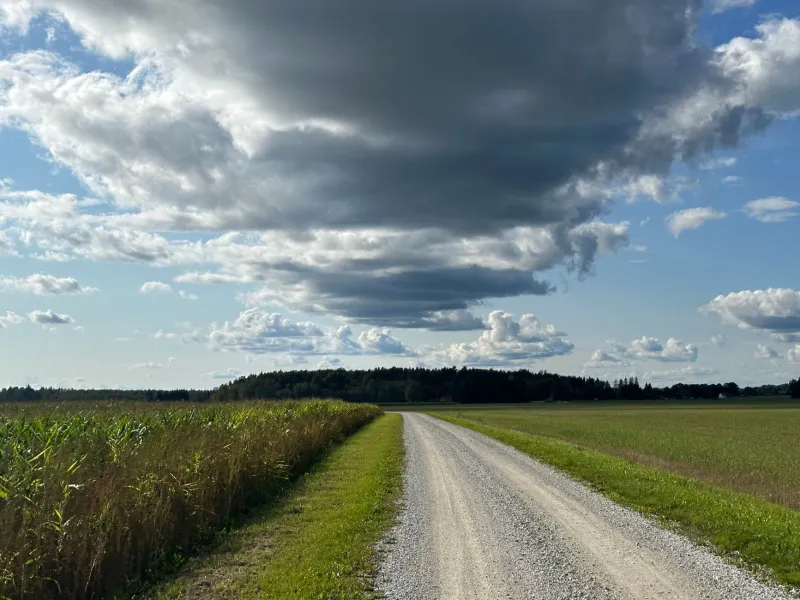
There's a county road about fourteen miles from his house that I've driven my whole life — old route, two lanes, cuts through the bottomland timber before it connects back to the highway. I drove it a hundred times growing up. I drove it at his funeral, on the way to the reception. I have never, in my memory, noticed the unmarked turnoff about three miles past the Carver Creek bridge.
I found it at dusk on a Tuesday in October. I'm convinced it's only visible at dusk — something about the angle of the light and the way the treeline sits. In full daylight it looks like a shallow ditch. At dusk the gravel shows, and you can see that it goes somewhere.
I didn't take it that day. I pulled over and sat with the engine running and looked at it and thought about my father's knee, which had apparently not prevented him from driving hundreds of miles at a stretch, and about the careful, loving dishonesty of a man who logged every oil change but left 3,800 miles blank. I thought about what a person drives toward in the last two years of their life when they don't want anyone to know they're going.
I went back the following week with the intention of driving in. I turned onto the gravel and went maybe forty yards before I stopped. I don't have a clean explanation for why I stopped. The road looked fine. The woods looked like woods. But the truck idled differently in there — a different pitch, subtle, the way an engine sounds in a tunnel — and I had the distinct, physical sense of being recognized. Not seen. Recognized. The way you feel when someone across a room says your name before you've looked up.
I reversed out onto the county road and drove home.
The truck is still in my driveway. I've been meaning to sell it. I keep not doing it. Last week I found a gas receipt in the glovebox I hadn't noticed before — the pocket behind the owner's manual, which I'd already checked. The receipt is dated fourteen months ago, from a station near the Carver Creek bridge. My father's handwriting on the back: just a mileage number, circled, and beneath it a single word I've read probably fifty times now trying to decide what he meant by it.
The word is again.