She Asked My Grandfather About Children Who Weren't Born Yet — I Met Her Last November
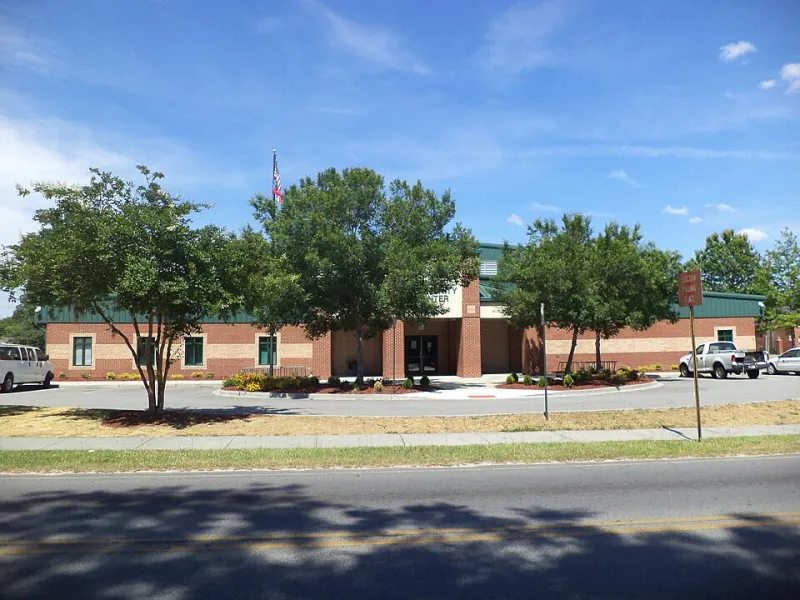
Photo: Michael Rivera, CC BY-SA 3.0, via Wikimedia Commons
She Asked My Grandfather About Children Who Weren't Born Yet — I Met Her Last November
My grandfather kept journals his entire adult life. Not diaries exactly — he wasn't sentimental about it. They were more like ledgers of the unremarkable: weather observations, grocery prices, the names of people he'd spoken to and what they'd said. He was a methodical man, an engineer by training, and he applied that same precision to recording the texture of ordinary days. When he died in 2019, my aunt boxed up thirty-two volumes and eventually they came to me, because I was the one who'd asked for them.
I read them slowly, a few pages at a time, mostly for the pleasure of hearing his voice in my head. It wasn't until I reached the volume covering 1971 that I found the entry.
November 2nd, 1971. Election Day. He'd gone to vote at the community center on Garrett Street, the one that's been a polling place in our town for as long as anyone can remember. The entry is longer than his usual style, which is the first thing that flagged it for me. He wrote that a woman at the check-in table had greeted him by his full name before he reached the front of the line. He assumed he knew her from somewhere, though he couldn't place her face. She was soft-spoken, he wrote, with gray hair worn pinned back and a quality he described, in his careful engineer's language, as settled — like someone who had been in that room for a very long time.
 Photo: Garrett Street, via www.gmlarchitects.co.uk
She asked him how Patricia and the baby were getting along.
 Photo: Patricia, via c8.alamy.com
My grandfather's wife was named Patricia. In November of 1971, my mother — their only child — had not yet been born. She arrived in March of 1973.
He wrote that he assumed he'd misheard, or that the woman had confused him with someone else. He thanked her, took his ballot, voted, and left. But he came home and wrote it down, which tells me it bothered him more than he let on. My grandfather didn't record things that didn't bother him.
I didn't think much more about it until last November.
I've voted at the Garrett Street community center my whole adult life. It's the assigned polling place for my precinct, and I'd never had a reason to think about it as anything other than a gymnasium that smells like old wood and floor wax twice a year. I stood in line, shuffled forward, reached the check-in table.
There were three volunteers working the table. Two of them I recognized vaguely from previous years — older men, the kind of retired guys who show up every election because they like having somewhere to be. The third was a woman sitting slightly apart from the others, with gray hair pinned back and an expression of settled, patient calm that I felt before I consciously registered it.
She found my name in the book before I said it.
Not quickly, not with the practiced efficiency of someone who's done this for years. She just looked at me and wrote the check mark before I opened my mouth. When I pointed this out — lightly, half-joking — she smiled and said, I remember faces. Her voice was quiet enough that I had to lean in slightly.
I took my ballot and started to move away. Then she said, How is your grandfather's collection coming along?
I turned around.
I had been sorting through the journals for about a year by that point. I had not mentioned this to anyone outside my immediate family, and the only family member who knew I had them was my aunt in Phoenix. I don't post about my personal life online. There was no reasonable way for this woman to know.
I asked her what she meant. She looked at me with that same settled expression and said something like, He was a careful writer. I always thought someone should read them.
I stood there longer than was appropriate for a polling place. The man behind me shuffled his feet. I asked her name. She said it was Maren, and she spelled it when I asked, M-A-R-E-N, like it was a perfectly ordinary thing to be asked.
Then she said: Give my best to the one you haven't told anyone about yet.
I don't know what she meant. I have an interpretation, and I'm not going to write it here because writing it makes it a fact, and I'm not ready for it to be a fact. But I know what she was referring to, and she was right that I hadn't told anyone.
I went back to Garrett Street in February, outside of election season, just to look at the building. There was a youth basketball league using the gym. I asked one of the organizers, a woman setting up a folding table near the entrance, how long the community center had been a polling location. She said she thought it had always been one, as far back as she knew.
I asked if she knew any of the regular volunteers. She named the two men I recognized. I described Maren. The organizer thought about it for a while and then said, I don't think I know who you mean. But there's always someone I don't recognize at those things.
I found one other journal entry, from 1983, that I missed on my first read. My grandfather voted at Garrett Street again. The entry is three sentences. The last one reads: The same woman was at the table. She asked after the baby. I did not correct her.
My mother was ten years old in 1983.
I've been thinking about what baby he meant. I've been thinking about it since February, and I think I'm getting close to an answer I'm not sure I want.