The Sunday Service on Millhaven Road Shouldn't Exist
Finding Faith Again
Margaret Hoffman had driven past the church on Millhaven Road dozens of times without really seeing it. That's how it is when you're running errands in a town you've lived in for thirty years — the landscape becomes invisible, just a series of familiar landmarks that register only as waypoints between home and grocery store, home and pharmacy, home and the increasingly frequent doctor appointments that come with being seventy-three.
But that first Sunday in March, something made her really look.
Maybe it was the cars. A modest collection of sedans and pickup trucks parked along the gravel shoulder, the kind of practical vehicles driven by practical people. Or maybe it was the sound drifting through her slightly open window as she slowed for the stop sign — voices raised in harmony, singing a hymn she remembered from childhood.
"Amazing Grace," she murmured to herself, and before she could think better of it, she was pulling onto the shoulder.
The Welcome
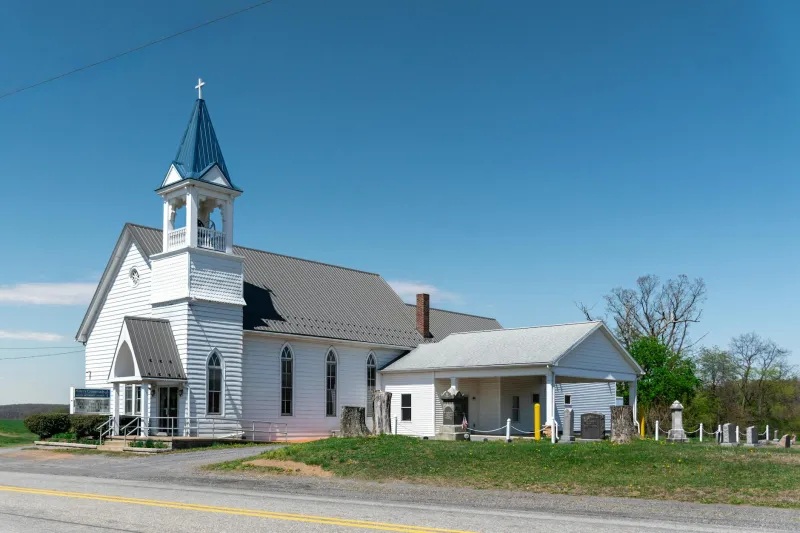
The building was exactly what a small-town church should be. White clapboard siding, simple steeple, windows that caught the morning light just so. A hand-painted sign by the front steps read "Millhaven Community Church — All Welcome," and Margaret felt something ease in her chest that she hadn't realized was tight.
 Photo: Millhaven Community Church, via i.pinimg.com
She'd been meaning to find a new congregation ever since St. Mark's downtown had closed last year. The building had been sold to developers, and the remaining parishioners had scattered to other churches around the county. But nothing had felt right. Too modern, too contemporary, too different from the simple Methodist services of her childhood.
 Photo: St. Mark's, via seedstint.com
This felt like coming home.
The congregation was small but welcoming. Maybe twenty people scattered across wooden pews that could have held twice as many. They smiled at her when she slipped in during the opening prayer, made room for her to sit, shared their hymnal without being asked. The kind of easy Christian fellowship she remembered from growing up in small-town Ohio.
Pastor Williams was a man in his sixties with kind eyes and a gentle voice that carried easily through the simple sanctuary. His sermon was about finding light in dark places, delivered with the comfortable authority of someone who'd been shepherding the same flock for years.
 Photo: Pastor Williams, via d-art.ppstatic.pl
A Personal Touch
After the service, Pastor Williams made a point of introducing himself. His handshake was firm but not aggressive, and when Margaret mentioned she was new to the area — a small lie, but easier than explaining about St. Mark's — he nodded thoughtfully.
"We're always happy to welcome new members," he said. "Though I have a feeling you're not entirely new to us. You have your mother's eyes."
Margaret felt her breath catch. "I'm sorry?"
"Dorothy Kelley, wasn't it? Before you married, of course. She used to attend services here, oh, must have been forty years ago now. Lovely woman. Had the most beautiful voice for hymns."
He was right, of course. Margaret's maiden name was Kelley, and her mother had indeed been Dorothy. But that was impossible. Margaret had grown up three states away, and her mother had never lived in this part of Pennsylvania. She'd moved here herself only after marrying Robert in 1971.
"I think you might be mistaken," Margaret said carefully.
"Perhaps," Pastor Williams smiled. "Memory plays tricks at my age. But you're welcome here regardless. We have coffee and fellowship in the back room if you'd like to stay."
The Congregation's Stories
Margaret did stay, drawn by curiosity and the promise of community she'd been missing. The fellowship hall was as simple as the sanctuary — folding tables, metal chairs, a coffee urn that had seen better decades. But the conversation was warm, the kind of easy chatter that comes from people who've known each other for years.
She found herself talking to Eleanor, a woman roughly her own age who'd been attending for "oh, fifteen years now, maybe twenty."
"It's such a blessing to have this place," Eleanor said, stirring cream into her coffee. "Especially after what happened to so many of the other churches. St. Mark's closing was such a shame."
"You knew about St. Mark's?"
"Oh, honey, church news travels fast in a small community. Pastor Williams mentioned it during prayers a few weeks back. Said we should keep the displaced congregation in our thoughts."
Margaret nodded, though she couldn't remember Pastor Williams mentioning St. Mark's during the service she'd just attended. Maybe she'd missed it during the opening prayer.
"How long has Pastor Williams been here?" she asked.
"Goodness, since before I started coming. Twenty years at least. Maybe longer. He's always been so good about remembering people's families, their histories. Makes you feel connected, you know?"
The Historical Gap
Margaret started attending regularly. Every Sunday at ten o'clock, she'd drive down Millhaven Road and join the small congregation for worship. The routine was comforting, the people genuinely kind, and Pastor Williams always had a moment to chat with her after services.
He continued to reference her mother occasionally, small comments that were both impossible and strangely accurate. He mentioned Dorothy's volunteer work with children, which was true — her mother had been a Sunday school teacher for years. He referenced her love of gardening, also accurate. Small details that could have been lucky guesses but felt too specific for coincidence.
It was during her sixth week that Margaret decided to do some research.
The county assessor's office was helpful enough, though the clerk seemed confused by her request for information about the church on Millhaven Road.
"Millhaven Road," the young man repeated, typing into his computer. "What's the address?"
"I don't know the exact address, but it's about two miles past the intersection with Route 15. White building, small steeple."
More typing. A frown.
"I'm not showing any active church properties on Millhaven Road. There's a vacant lot at 2847 Millhaven — that's about where you're describing. But no buildings."
"That can't be right. I've been attending services there for over a month."
The clerk's frown deepened. He turned his monitor so she could see it. "According to our records, there was a church at that location. Millhaven Community Church. But it burned down in 1978. The foundation was cleared in 1980, and the property's been vacant ever since."
The Return
Margaret sat in her car outside the assessor's office for a long time, staring at the printout the clerk had given her. Property records going back fifty years, showing the clear progression: church built in 1923, expanded in 1954, destroyed by fire in 1978, foundation removed in 1980, property listed as vacant lot since then.
No recent permits for reconstruction. No variance requests for new construction. According to the county, 2847 Millhaven Road had been an empty lot for over forty years.
She drove there directly from the assessor's office, even though it was Thursday and there would be no service. She needed to see it again, to confirm what she knew was there.
The church sat exactly where it had been every Sunday for the past six weeks. White clapboard, simple steeple, the hand-painted sign welcoming all. It looked solid, real, permanent. Sunlight caught the windows at the same angle it always did.
But when Margaret got out of her car and walked closer, she noticed things she'd missed before. The paint, while clean, had an odd quality to it — not quite matte, not quite glossy, but something in between that seemed to shift depending on the angle of view. The windows reflected light but not quite correctly, as if the glass was thicker or thinner than it should be.
And when she pressed her hand against the front door, expecting to feel solid wood, her palm met resistance that felt more like memory than matter.
The Final Service
She went back that Sunday, of course. She had to.
The service proceeded exactly as it had for the past six weeks. The same hymns, the same gentle sermon, the same warm fellowship afterward. Pastor Williams asked about her week with genuine interest. Eleanor shared news about her grandchildren. Everything was exactly as it should be.
Except that Margaret now noticed the small details she'd missed before. The way conversations seemed to circle back to the same topics week after week, as if the congregation was working from a script they'd memorized decades ago. The way the light through the windows never quite matched the weather outside. The way Pastor Williams's references to current events were always just slightly off, as if he was remembering news from years past.
During the closing prayer, Margaret opened her eyes and looked around at the bowed heads of the congregation. In the strange light filtering through those impossible windows, she could see them clearly for the first time.
Eleanor's face had the waxy quality of old photographs. The man in the front pew who always sang tenor had hands that seemed translucent when the light hit them right. Pastor Williams himself, when Margaret really looked, had the careful stillness of someone concentrating very hard on appearing solid.
"Amen," the congregation said in unison, and Margaret realized she could see the far wall through their bodies when they stood.
She left during fellowship, claiming she had an appointment. Pastor Williams walked her to the door, as he always did.
"Will we see you next Sunday, Margaret?" he asked.
"I don't know," she said honestly.
"Well, you're always welcome here. Your mother would be proud to know you've found your way back to faith."
Margaret turned to ask him what he meant, but the door had already closed behind her.
The Choice
She's been back every Sunday since.
Not because she doesn't understand what's happening — she's not stupid, and she's not in denial. The church burned down in 1978, and everyone who attended it probably died years ago. She knows this.
But the thing is, they remember her mother. They welcome her with genuine warmth. The hymns are the ones she grew up singing, and Pastor Williams's sermons speak to something in her soul that's been quiet for too long.
So what if the building exists only on Sundays? So what if the congregation is more memory than flesh? She's seventy-three years old, her husband is gone, her children live in other states, and St. Mark's is a pile of rubble waiting to become condominiums.
This is the only place that feels like home.
And sometimes, during the closing prayer when the light slants just right through those impossible windows, Margaret wonders if maybe she's becoming a little translucent herself.
The thought doesn't frighten her as much as it should.